A German or other European industrial company establishes a small local team in Southeast Asia. The team is extremely capable – hands-on, fast, collaborative – but stretched thin. And purely operational: support sales, run the odd event, keep the lights on, as they are told to do.
Nobody has the time or mandate, not to talk about the budget, to step back and ask whether the brand and marketing approach that works back home actually works here. So the local team does what any small, unsupported team would do: it copies the playbook from home. And if it's too complex – or simply too big – it applies what they understand well.
That gap – between what headquarters assumes travels and what actually lands with a local audience – is the thread running through this conversation.
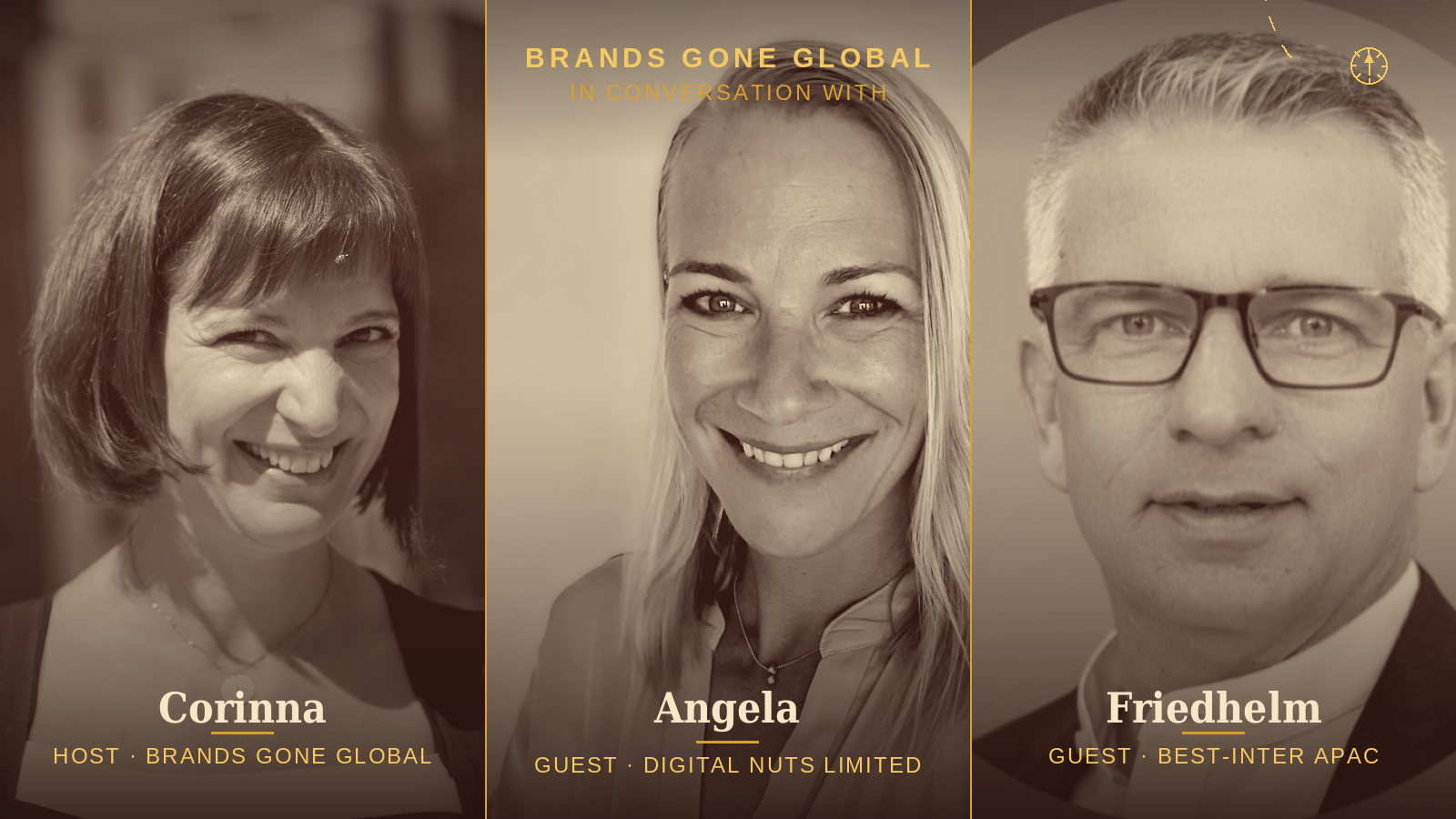
For this episode, I sat down with two people who see it from different angles: Angela Exner, who works in digital marketing from Bangkok with her company, Digital Nuts Limited, and Friedhelm Best, a cross-border interim manager who has spent 25+ years in industrial Mittelstand companies expanding into Asia Pacific.
The brand isn't as well-known as headquarters thinks it will become soon
Friedhelm: When we talk about companies whose home market is Germany or Europe, their brand is often genuinely well known – at home. Look at local teams in Asia Pacific, and you'll find some customers who already know the brand, usually because the company has been active in the region for a while. But if you want to reach new local customers, you need to do real brand building – you have to sell the company first, tell people who you are and why you're different, before you can sell the product. Headquarters' playbook often underestimates this. There's an assumption that trust and authority already exist, especially for German brands, when in a new market they still have to be built. That gap shows up first in language – and not in the way most people expect.
Corinna: On numerous projects, I localized brand visuals and found the wording was written at a level that only makes sense either in a mature or a home market – where basic awareness already exists, or where culturally relevant jokes and concepts can be understood. Drop that same copy or concept into a new market, in a different language system, where translation is trickier than German-to-French or German-to-Spanish. It simply stops being understandable. And that's a problem right at the top of the funnel – you lose people before you ever get the chance to walk them further down it. For industrial companies specifically, with their technical language, this is especially critical.
Friedhelm: I've been in that exact situation myself – thinking, “we need to give wider context for customers in Asia,” and getting resistance, because in Europe you go straight to the technical features. You can't just copy-paste an article that works in a European trade magazine. Here, readers want to know what you are doing, and why you are serving this industry, before you get anywhere near specs and figures. You have to pick up customers from a broader starting point.
“You have to sell the company first, before you can sell the product.”
Digital channels don't behave the same way twice
Friedhelm: In more than 25 years in these companies, the shift in customer touchpoints has been enormous. It used to be a sales call, a phone conversation, an exhibition visit, maybe a printed magazine. Now customers have social media, websites, webinars, AI – and by the time they reach a salesperson, they've often already consumed a lot of information on their own. On top of that, in Southeast Asia, social media users skew notably younger than in Europe, which means they consume content differently – more video, more visual, less appetite for the long, detail-heavy text that European B2B audiences still expect.
Angela: Exactly – and attention spans generally have gotten shorter. There's so much content competing for the same eyeballs that genuinely understanding the audience is no longer a nice-to-have exercise: what they want to see, how long they'll actually watch (often 35–40 seconds max for video), and what will make them stop scrolling. For industrial companies, that doesn't mean only happy faces and machines – the technical substance still has to be there – but it means leading with something that earns attention first, rather than trying to convince someone of everything in the first three seconds.
Friedhelm: That is true – and the harder question is whether industrial companies are actually ready for it. What I've learned is that the mindset in a lot of engineering companies is still “we need business cards, and our salespeople will chase them.” What Angela described is really about marketing-qualified leads – leads that need to be warmed up before they're ready for a sales conversation. In one project in Southeast Asia, we built this funnel from scratch: webinars, white paper downloads, social posts. Over four years, we generated 11,000 marketing-qualified leads – without dumping them all straight onto the sales team, which would have overloaded them. That discipline, treating lead generation as a staged process rather than a one-shot handoff, was something even the European organization hadn't fully worked out.
The handoff between marketing and sales is where campaigns actually die
Angela: One thing that's often missing – at headquarters and in local teams – is that sales isn't prepared for the leads a digital campaign generates. You run a campaign, leads come in fast, and if nobody's ready to qualify and follow up, they just sit in an Excel file for weeks. I've seen this repeatedly: the campaign worked, the leads were there, and they went nowhere because nobody picked them up in time.
Friedhelm: I can put a number on that. I'd tell sales teams: think of a lead as a $500 check. If you don't follow up within a week, it's worth half that. In four weeks, it's zero. It's gone. That framing created real discipline – but it only works if marketing and sales agree on the rules before the campaign runs, not after. We started making it literal: agree on budget, target lead volume, and cost per lead before committing – sometimes in a shared project charter, so both sides only greenlight a campaign they've actually agreed to convert.
“Think of a lead as a $500 check. If you don't follow up within a week, it's worth half that.”
Corinna: The pattern where sales doesn't follow up on leads isn't new – I saw it in traditional campaigns too, long before anything was digital. We'd send out mailings, ask sales to prioritize the top 10%, and the follow-up still wouldn't happen. A marketer can't force sales to act, even inside the same team. This has to be a management-level priority, not a marketing-department request. And the two of you have each pointed at the same root issue from different sides: marketing needs to invest in people who are actually qualified for the job – not the “the intern can handle social” approach – and someone needs to own the full lead-to-order journey end to end, instead of letting marketing and sales operate as silos that hand off blame instead of leads.
Friedhelm: Exactly – in a lean local organization, that's sometimes one manager owning both functions, which has real advantages. But whoever owns it, it has to be one person accountable from lead to order. Split it into silos, and it won't work.
If you don't track the brand, you can't prove it worked
Friedhelm: There's definitely room for improvement here. Companies often track customer satisfaction diligently, but when it comes to brand awareness, many simply don't know where they stand. In one company, we ran a baseline study – how well known is our brand, really – and it was an eye-opener. From there we could actually measure whether activities were moving the needle. On the lead side, we did the same: track marketing-qualified leads, set targets, define how many convert to sales-qualified, and track the sales team's conversion rate on those. With three or four KPIs like that, plus a brand awareness baseline, you get a real read on what's working.
Corinna: That's the piece that's often missing entirely: without brand tracking, you have no KPI for brand building at all – everything about it stays anecdotal. In digital marketing, you at least have built-in numbers, which is part of why it's such a strong lever. But brand awareness has to be measured deliberately, especially in a market like Asia where, unlike at home, you can't assume everyone already knows you.
“Without brand tracking, you have no KPI for brand building at all.”
The takeaway
Three different vantage points – brand strategy, digital execution, and on-the-ground interim leadership – kept arriving at the same root cause: companies expanding into Southeast Asia default to running their home-market playbook, just translated. Real market entry needs local teams with actual marketing expertise (not an intern with a task list), messaging rebuilt for markets without existing brand awareness, a lead funnel that sales is actually resourced to work, and enough brand tracking to know if any of it is working at all.
Where has the “it worked at home, so it will work here” assumption cost your organization more than it saved?
About this episode's guests
Angela Exner, owner of Digital Nuts Limited, is working on digital marketing and localized campaign strategy across Southeast Asia.
Friedhelm Best, owner of BEST-inter APAC Pte Ltd, is cross-border interim manager who has served as Managing Director and Vice President across seven countries in Europe and Asia Pacific, helping German Mittelstand companies build sales, marketing, and operations in the region.