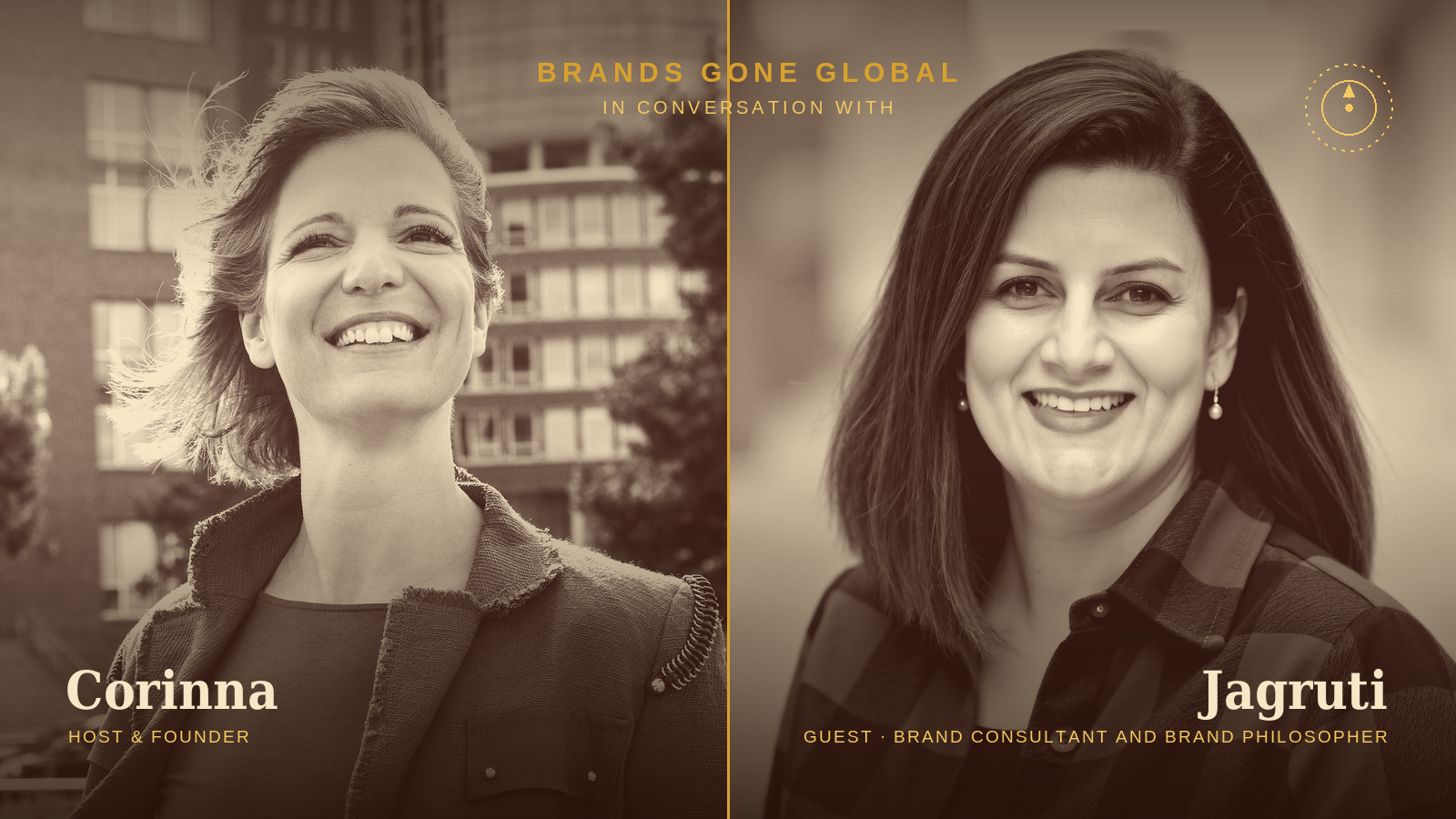
“Brand Philosopher” – what’s behind the title
Corinna: You call yourself a brand philosopher. What's behind that?
Jagruti: It sounds fancy, right? But really, it's about making the case that brand is a philosophy of trust, behaviour, and memory – built to last, not just to look good. Most companies still think brand work ends with a colourful logo and a catchy tagline, job done. Over 20 years across real estate, pharma, consulting, BFSI, and logistics, I've watched the same pattern play out everywhere: most leaders treat brand as a marketing task when it's actually a leadership discipline.
“Brand is less about how a company looks and more about how it behaves, decides, and is remembered – especially in today's AI world.”
Corinna: That framing resonates a lot, especially coming from B2B, like both of us do. In B2C, brand's relevance as a leadership responsibility is clearer, because so much revenue is earned directly through it. In B2B, if you're lucky, you have a brand-aware managing director – and then he or she becomes the brand, in a way, but it's rarely translated methodically across the organization. Why don't companies recognize brand as a management function, and why doesn't it even get a seat at the boardroom table?
Brand risk is financial risk
Jagruti: You've touched the most sensitive nerve in the system. A brand's role at the top management level is indeed critical – it belongs in the boardroom, not three layers down in a marketing sub-section chasing momentary gratification. It's tied directly to valuation and risk, which makes it a governance issue as much as a communications one. Most CEOs can recite their EBITDA or NPS targets instantly, but ask them what their brand actually stands for, and most may struggle.
“Not a marketing gap but a governance blind spot.”
And markets are already pricing this in real time: the Boeing 737 MAX crisis, the Volkswagen emissions scandal – both moved market cap within days, not quarters. Brand risk is financial risk, and a very real one.
The case for a Chief Reputation Officer
Jagruti: I've written on this quite passionately in recent columns, because I see an emerging role here that I'd genuinely like to see become an official designation: a Chief Reputation Officer. In my view, it's the most important and most critical role companies will need in the coming years. Most leaders underestimate how much brand shows up daily – in pricing decisions, hiring, vendor selection, how a company handles a single customer complaint online. It's no longer about press releases and billboards; it's lived and led from the inside out. Gone are the days when a journalist wrote something nice, and we screenshotted it around the office as proof we'd arrived.
Corinna: That's a fascinating perspective, because it asks the organization to think about reputation at an overarching level – something a good MD is often already doing, just without the designation and without being a brand expert. My concern is: for such a role to work, it has to stay very close to the business, or it becomes hard to implement. Have you thought about how this cascades down – say, reputation owners in each department, reporting into that function?
Jagruti: It's early days in my thinking on this, but here's where I land: brand comms heads are already doing pieces of it. What I mean by Chief Reputation Officer is a more strategic, more authoritative function – one where real decisions get taken, not just recommended. It could sit within marketing comms, or in the CEO's office; where matters less than what. What matters is that it's one person with a 360-degree view of how marketing, communications, brand, and AI intersect, holding a direct mandate from the CEO or founder, backed by an extended team. Not a scattered group of “reputation executives” that nobody quite understands.
AI as the first audience
Corinna: Which brings us back to that familiar truth: brand should have a seat at the boardroom table, but rarely does. On AI as this new mediator and first audience – I think of it almost like the early days of search engines, where suddenly we had to optimize for Google. Now we have GEO, AI optimization. Is that too simplified a way to look at it?
Jagruti: You're spot on with the instinct, but very few people grasp how fast this shift is happening. We've moved from SEO to GEO, and now even to something like personalized optimization, PEO is at our door. What I'm saying today might not even hold tomorrow. What we're trying to build instead is a safe, trustworthy, credible foundation that doesn't shake with every new trend.
“Today, AI is the mediator, and arguably the first audience.”
So even if your company is working meticulously on content strategies, whether AI chooses you or not becomes the biggest differentiator!
Corinna: Let's talk about another risk. With generative AI, everybody sounds great today. But if brand governance isn't done well across sales, service, and installation – wherever the human touch still matters – the gap between AI-polished communication and the real experience widens instead of narrowing. And that hurts trust badly, especially in B2B.
Jagruti: Very much so. Human touch is going to be the most critical factor in choosing between all the equally polished, AI-led communications out there. If the output only speaks “AI language” without genuinely helping the customer get what they need as well as personalised post sales service, that missing human intervention becomes a huge gap communicators will have to solve for.
Brand as an investment, not an afterthought
Corinna: Let's talk about how companies actually get started. You said brand shouldn't be a fancy term that shows up only at the end of a discussion or when a crisis hits.
Jagruti: Exactly.
“Brand management should be looked at as an investment that started yesterday, not today.”
A brand audit looks at brand presence first – not just what employees or media think, but a full 360-degree view: investors, social media, employees, prospective employees. Once you understand where you actually stand, you move into brand architecture and narrative building, so that whichever channel you use – WhatsApp, email, a town hall et al – all speak the same language. That consistency is also what AI picks up on and reinforces.
How to run a brand audit without breaking the bank
Corinna: What would be your recommendation when it comes to a brand audit? Because I absolutely agree this is something that's often simply not done. And if it is done, that's the flip side: big agencies offer very expensive brand audits, and mid-sized companies who are still building their brand awareness in the first place shy away from the cost and effort. So, if you were advising the MD of a mid-sized company on how to run a brand audit effectively without spending a fortune, what would that look like?
Jagruti: It's a personal pocket choice, really – how much depth of work one is willing to invest in. A surface-level audit gives you a quicker, cheaper plan. If you're building a legacy for the next 20, 50, 100 years, you invest more in research depth & planning ahead to make a strong foundational plan – and that comes at a premium. But that one-time investment is what drives the narrative for a legacy brand.
Brand equity and the exit question
Corinna: Let's look at brand equity from a top management and investor perspective – whether you're thinking of a sale tomorrow or handing a family-owned company to the next generation.
Jagruti: At one of my previous companies, I ran a brand refresh project right when the company was considering an IPO. The timing mattered, because how a company shapes its image and credibility in line with its brand plan and narrative directly affects how investors see it. If you're anticipating a change – an M&A or an IPO or simply a growth trajectory – getting your house in order and building a legacy brand creates the real financial advantage to the company.
This conversation continues in a second episode focused on the localization of brands between India and Europe.
Jagruti Kirloskar is a brand consultant and columnist based in Mumbai. With over two decades of experience leading marketing and communications across industries including real estate, pharma, consulting, BFSI, and logistics, she has built brand narratives at the intersection of global strategy and Indian market realities. Her academic grounding spans Symbiosis Institute of Mass Communications (SIMC), Mudra (MICA), ARU Cambridge UK, an exchange at ZHAW Zurich, and a Sustainable Business Strategy certification from Harvard Business School. She can be reached on LinkedIn.